 |
 |
 |
 |
 |
 |
 |
 |
 |
 |
 |
 |
Fairs Cup Trophy play off - Nou Camp - 45,000
Scorers: Jordan
Barcelona: Sadurni, Rife, Eladio, Torres, Gallego, Costas, Rexach, Carlos, Duenas, Marcial, Asensi (Fuste)
Leeds United: Sprake, Reaney, Davey, Bremner, Charlton, Hunter, Lorimer, Jordan, Belfitt, Giles, Galvin
One lost count of the number of occasions on which
United had triumphed against the odds, when they had emerged successfully
from seemingly impossible conditions: in 1965, when ten
men survived in Turin after the loss of Bobby Collins with
a badly broken leg; the chaotic Elland
Road clash with Valencia in 1966 before United won 2-0 in
Spain; the repeat performance in Valencia
in February 1967; the historic goalless
draw in the Nep Stadium against Ferencvaros when United captured
the trophy for the first time in 1968; the memorable fightback
a month later from a 2-0 deficit at home
to Standard Liege to win 3-2; the victory
at Anfield against Liverpool in April 1971; and the two-legged
stalemate against Juventus when United
won the trophy for the second time at the beginning of June. It was only fitting, therefore, that, when UEFA
decided to stage a play off to decide who would retain the trophy
perpetually following its replacement by the UEFA Cup, United
should be one of the participants. Their opponents were the first
winners, Barcelona, who had an even better record in the tournament,
though their glory days were a distant memory. The Spaniards were
the first winners of the trophy in 1958 (after a tournament that
lasted three years), retained the trophy after a two-year campaign
in 1960 and regained it in 1966. They were also beaten finalists
in 1962. Arrangements were made for the two teams to face
each other in Barcelona's Nou Camp on 22 September 1971 on a winner
takes all basis. Don Revie was justifiably
proud of his club's record in the competition, saying, 'We really want
to win this cup. It would give us a permanent memento of our many years
in Europe. We have had to produce something against the odds many times
before in Europe and I am hoping we can do it again.' Having watched Barcelona in action while on holiday in Spain,
Revie conceded the difficulty of United's task, describing Barca as 'a
great side'. His view was endorsed by assistant manager Maurice Lindley,
who watched them beat Ireland's Distillery 3-1 in the Cup Winners' Cup
a week before the game. For all Revie's playing up of the status of the match, it
was not a priority for him. It came at an inconvenient time for Leeds,
between the two legs of the UEFA Cup-tie against
Lierse and was one of ten fixtures in September. However, financial
incentives increased its attraction for a club
still reeling from the loss of income brought about by the closure of
Elland Road. Tony Hill: 'There was also the matter of United receiving
thirty per cent of the gate receipts for the match, which was part of
a festival to celebrate the opening of Revie was also stressed by a worrying injury list
and confirmed that he would have to select from a pool missing
Allan Clarke, Paul Madeley, Terry Yorath, Terry Cooper, Mick Jones,
Eddie Gray and Mick Bates. His travelling party included untested reserves
Jimmy Mann (18), Sean O'Neill (19) and John
Saunders (21); David Harvey, John Faulkner, Chris Galvin,
Nigel Davey, Rod
Belfitt and Joe Jordan were also in the party. The recognised
first teamers who travelled were Gary Sprake, Paul Reaney, Billy
Bremner, Jack Charlton,
Norman Hunter, Peter Lorimer and Johnny Giles. Revie commented, 'It could have been a real classic if we
had had our full side out,' implicitly conceding the game before it had
even kicked off. There were fears that the occasion would be ruined
by the weather; when United flew into Barcelona it was under overcast
skies that recalled memories of the washout they had faced when
meeting Juventus in Turin the previous May. There had been serious
flooding in many parts of the city but mercifully the rain held
off on the night of the game. The atmosphere was warm and clammy
as the match commenced. Davey, Jordan, Belfitt and Galvin were all in the
starting line up, which was nevertheless a competitive selection,
and United were clearly up for the battle. Neither team held back
in the opening exchanges and Hungarian referee Istvan Zsolt, who
had officiated in two World Cup final series, had a challenging
time. Barry Foster: 'Feeling crept into the game as early as the
seventh minute when the referee had words with both Marcial and Giles,
and 15 minutes later he had both the inside-forwards together again for
a lecture. This time the captains were also spoken to by the referee but
within three minutes there was more rough play when Bremner was brought
down in midfield by Gallego. The referee had more words for the full-back
and Leeds did well to keep their heads although Davey was spoken to after
a heavy tackle on Rife ... Several times the referee called players together
after rough exchanges. Leeds players kept their heads well and withstood
some over zealous play by the Spaniards.' While Barcelona had the best of the early moments,
United came more into the contest as the game neared half time,
though neither team troubled the scorers. Five minutes after the restart, however, the home
side took the lead. The move was sparked by Marcial on the left,
feeding Teofilio Duenas. Two United defenders might have intercepted
the pass, but the centre-forward, whom many considered the Spaniards'
best performer, took the ball smoothly and crashed a shot against
the bar. It bounced down over the line but Duenas swept away any
doubt and controversy by following up to slam it into the back
of the net. Leeds fashioned an immediate riposte, equalising
within two minutes. The referee awarded them That setback drove Barca on to greater efforts and
they gradually turned up the pressure, threatening on several
occasions to grab a second. Undeterred, United showed there was still something
in their attacking locker when they broke out dangerously, and
Johnny Giles was unlucky when his crafty lob only found the top
of the side netting. It was only a temporary reprieve; after Barcelona
brought on Fuste for Asensi to pep up their attack in the 80th
minute, they had to wait only three minutes to regain their advantage. Duenas was again the scorer. He was perfectly placed
to collect a defence-splitting pass down the right and he was
the epitome of cool confidence as he hammered the ball past Gary
Sprake. Two minutes later he came close to completing his
hat trick; he beat Sprake with a fearsome drive from the edge
of the area but Paul Reaney was perfectly placed to head the ball
off the goal line. That was the final action of the contest and United
had to give best to the home side at the close. They had put on
a gallant show if they were not quite at their best, and they
earned the respect of the Spanish press for their never-say-die
attitude. The Guardian: 'It says much for Leeds' reserve strength
that they were able to match Barcelona in initiative and tenacity for
long periods, but as the match went on, the Spaniards gained a measure
of control through their experience. Leeds failed to find another opening
in spite of several attacks in which Jordan and Lorimer proved themselves
equal to Sprake as the outstanding members of the side.' When the United party landed back in West Yorkshire
there was some worrying news. They had to leave their names and
addresses with customs officials at Leeds and Bradford Airport
because they had been to a region where cases of cholera were
still known to occur; they were told to contact their doctors
if they felt ill. Happily none of the players or officials suffered
any after effects Reflecting on their years of European competition,
Don Revie said that it had provided his side with a great deal
of valuable experience and had given Leeds a deep insight into
the tactics of the game in many parts of Europe. It had helped
the players to develop as footballers and been of great assistance
financially, providing the money needed for the necessary development
of the Elland Road ground. Revie was delighted with the performance at the
Nou Camp and was quick to point out that he had paid fees for
only two of the side that lost against Barcelona, Giles and Jordan. According to Barry Foster in the Yorkshire Post,
'Mr Revie said he had mentioned the fact that his side would be playing
four matches in eight days to a Barcelona official who had told him, "You
are crazy. Our players would not do that." The official had said
that Barcelona are involved in only about 40 matches each season, including
their European commitments, and he was astonished when Mr Revie said Leeds
had played something like 60 matches each season for the past six years. 'The Spaniards, Mr Revie was told, switch their Sunday League
matches to Saturday before European ties, and he believed it might be
a good idea if English clubs moved their games from Saturday to Friday
night before European cup-ties. "It might be worth mentioning to
the Football League," said Mr Revie.'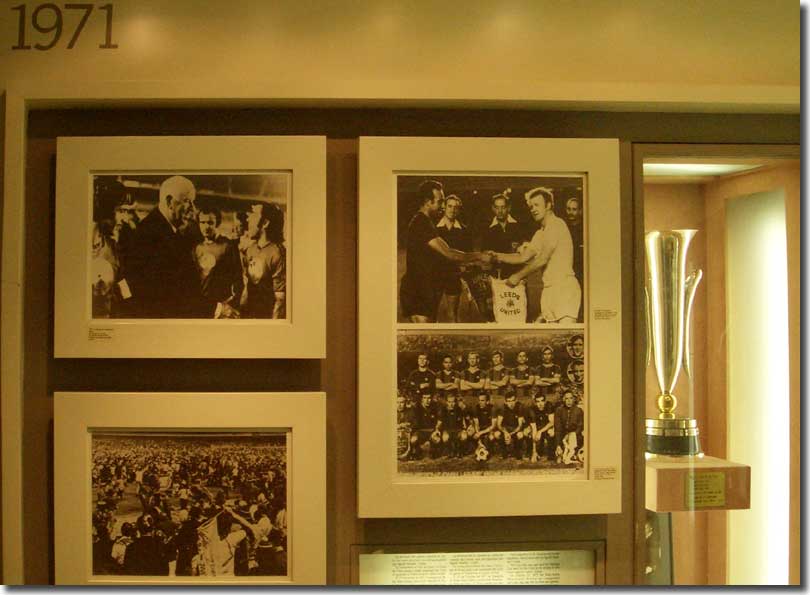 By
1971, Leeds United were freely acknowledged as competitors supreme in
the European Fairs Cup tournament: in five attempts to win the stylish
silver trophy, they were successful twice, runners up on one occasion
and beaten semi-finalists in their first campaign. Of their 53 Fairs Cup-ties,
United won 28 and lost 8, with a goals ratio of 92-40. On only nine occasions
did they concede more than one goal in a game, registering 23 clean sheets.
Impressive stats indeed: in short, they had perfected the secret of playing
the two-legged European game, keeping things tight for the most part,
but breaking incisively to score at vital points in big games.
By
1971, Leeds United were freely acknowledged as competitors supreme in
the European Fairs Cup tournament: in five attempts to win the stylish
silver trophy, they were successful twice, runners up on one occasion
and beaten semi-finalists in their first campaign. Of their 53 Fairs Cup-ties,
United won 28 and lost 8, with a goals ratio of 92-40. On only nine occasions
did they concede more than one goal in a game, registering 23 clean sheets.
Impressive stats indeed: in short, they had perfected the secret of playing
the two-legged European game, keeping things tight for the most part,
but breaking incisively to score at vital points in big games.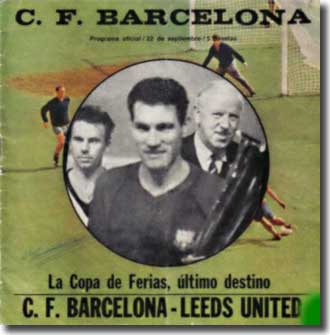 a
multi-sports centre in the Catalan city.'
a
multi-sports centre in the Catalan city.'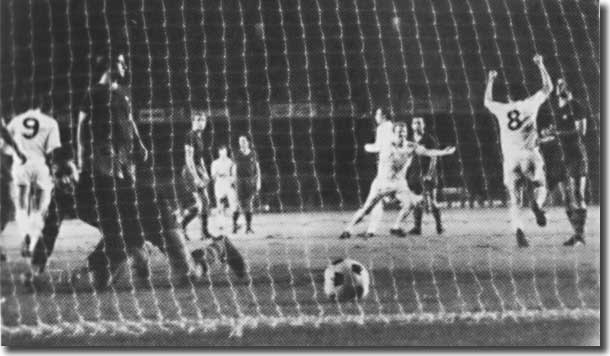 a
free kick 25 yards out and Peter Lorimer thundered in a fearsome
effort from the dead ball. Like many before him facing the Scot's
power, goalkeeper Salvador Sadurni could not gather the shot and
19-year-old Joe Jordan, making his first start for United, moved
in quickly to despatch the loose ball.
a
free kick 25 yards out and Peter Lorimer thundered in a fearsome
effort from the dead ball. Like many before him facing the Scot's
power, goalkeeper Salvador Sadurni could not gather the shot and
19-year-old Joe Jordan, making his first start for United, moved
in quickly to despatch the loose ball.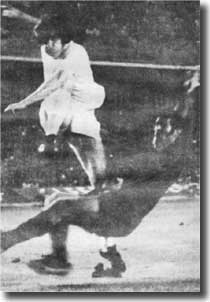 but
there were reported to be some cases of infection among returning
United supporters.
but
there were reported to be some cases of infection among returning
United supporters.