 |
 |
 |
 |
 |
 |
 |
 |
 |
 |
 |
 |
UEFA Cup first round second leg - Elland Road - 18,680
Scorers: None
Leeds United: Shaw (Sprake), Reaney, Cooper, Yorath, Faulkner, Madeley, Lorimer, Mann (Hunter), Belfitt, Bates, Galvin
Lierse SK: Engelen, Dierckx, Krivitz, Michielssens, Golen, Vermeyen, De Ceulaer, Davidovic, Janssens, Denul, Ressel
When Belgian club Lierse SK were drawn against Leeds United
in the inaugural staging of the UEFA Cup in 1971 it looked an utter mismatch:
United were the supreme exponents of European tournament football and
had won the predecessor Fairs Cup trophy twice since 1968; the Belgians
were naive minnows, having only ever played three European ties in their
65-year history. They had been beaten 5-0 by Barcelona in the European
Cup in 1960; after Lierse beat Apoel of Cyprus in the Cup Winners Cup
in 1969 they went out in the next round 8-0 on aggregate to Manchester
City. Surely, the contest would be a mere formality for Don
Revie's battle-hardened warriors? The odds lengthened considerably as a result of the first
leg in Belgium on 15 September. Fielding a side that included four reserves
in Mick Bates, Terry Yorath, John Faulkner and Chris Galvin, United won
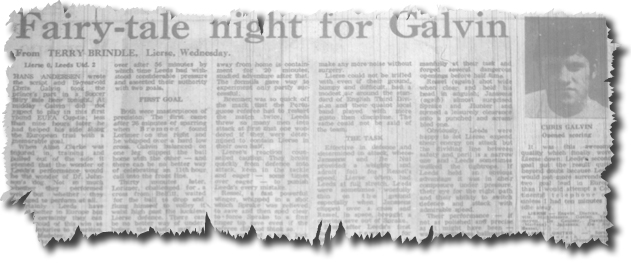
2-0 with goals from Galvin and Peter Lorimer. Terry Brindle in the Yorkshire Post: 'Leeds have
played better in Europe but equally certainly they can be as proud of
this win as of any. Injuries to Charlton, Cooper, Madeley, Jones and then
Clarke put the victory in amazing perspective. 'The match was virtually over after 56 minutes by which
time Leeds had withstood considerable pressure and exerted their authority
with two goals. 'Both were masterpieces of precision. The first came after
26 minutes of sparring when Bremner found Lorimer on the right and he
whipped over a hard, low cross. Galvin, balanced on one leg, clipped the
ball home with the other. 'Leeds' time tested formula for European competition away
from home is containment for 20 minutes, studied adventure after that.
The formula gave way to experiment only partly successful.' The Belgians had come a long way since their drubbing by
Manchester City two years earlier. In fact, despite the first leg score,
they had given United a number of problems. Brindle: 'Lierse's reaction
counselled caution. They broke quickly from defence into attack, keen
in the tackle and eager - sometimes over eager - to punish Leeds' every
mistake. 'Ressel, a fast, powerful winger, whipped in a shot which
Sprake was relieved to save and then sped clear to force Sprake to a fine
fingertip save even if the referee did not think so. He awarded a goal
kick to Leeds, much to the chagrin of the noisy locals. I doubt if 18,000
voices could make any more noise without surgery. 'Lierse could not be trifled with even if their ground,
bumpy and difficult, had a modest air around 'Even after Leeds' first goal - reward for dangerous probing
but no real indication of sweeping superiority - Lierse stuck manfully
at their task and forged several dangerous openings before half time.
Ressel (again) shot wide when clear and held his head in anguish; Janssens
(again) almost surprised Sprake and Hunter and turned a leisurely clearance
into a punched and scrambled one. 'Obviously, Leeds were happy to let Lierse expend their
energy on attack but the dividing line between safety and peril is a narrow
one and Leeds sometimes walked the tightrope. If Leeds held an obvious
advantage it was in their composure under pressure, their eye for the
right path and their ability to switch defence and attack with admirable
speed. 'Their performance - if not as polished and precise as it
might have been - was nevertheless hallmarked with the stamp of experience
and deep fundamental quality. It was this awesome quality which finally
wore Lierse down. Leeds' second goal put the result quite beyond doubt
because Leeds would no more surrender a two-goal lead in Europe than I
would attempt a continental telephone call unless I had ten minutes to
idle away.' Lierse manager Frank De Munck had a simple ambition for
the second leg at Elland Road: to avoid disgrace. He told the Yorkshire
Post, 'Leeds are such a talented side, even with so many players injured
that I do not think we can expect to beat them. As a coach, it is my job
to be realistic as well as optimistic. We will do our very best, but I
think we will have to be satisfied if we can avoid a very heavy defeat.
The match will be a very valuable one for our players; it will be a great
experience. We will try to win, of course, but we must be honest and say
that we will be happy if we do not lose by more than, say, 2-1.' The ever-cautious Don Revie took a gamble with his
selection, calling up a number of his reserves: Scottish 17-year-old
goalkeeper John Shaw was given his first team debut, while 18-year-old
forward Jimmy Mann had his first start in the No 8 shirt. Terry
Yorath deputised for Billy Bremner, John Faulkner for Jack
Charlton and Paul Madeley played in Norman Hunter's stead.
Rod Belfitt, Mick Bates and
Chris Galvin were also in a side that had an unusual look to it,
with Reaney, Cooper and Lorimer the only first teamers playing
in their accustomed position. Revie was confident that even a shadow side would
have enough about it to preserve United's first leg advantage.
However, he opted for some insurance by naming Gary Sprake and
Hunter among the substitutes. Before the first leg, Revie had said: 'Lierse are a fit
and well organised side with two capable front runners and they have obviously
improved in the past couple of seasons. It will be difficult, especially
in view of our injury problems. But the side usually rises to the occasion.'
His caveats about the Belgians' attack were proven horribly accurate in
the Elland Road return. United began the second leg looking calm and assured and
clearly expected to win the game easily. Michael Carey in The Guardian:
'Shaw's handling was understandably shaky early on - it was his first
appearance - yet for 20 Things took a dramatic turn in the thirty-second
minute. Frans Vermeyen's shot was blocked but centre-forward Frans
Janssens came racing in to smash a shot through the United defence
and into the net via a deflection off Paul Reaney. If that was a shock to the system, within six minutes
there was a seismic wave of anxiety sweeping across the West Riding. Four minutes after the first goal, Lierse were level
on aggregate. Paul Madeley lost possession in midfield, and United
stopped in anticipation of being awarded a free kick for obstruction.
They were waiting for a whistle that never came and the Belgians
pressed on, Janssens laying the ball on a plate for Peter Ressel
to score. Lierse were back on the offensive straight from the restart,
regaining possession and striking at the heart of United's defence. The
nervy Shaw made a cardinal error to grant the Belgians the softest of
goals. Carey: 'Shaw allowed Ressel's centre to go through his hands or
legs, or both, and Janssens scored the third. 'Leeds had all their substitutes warming up at half time
and it was no surprise that Sprake replaced Shaw and that Hunter took
over from Mann and began a one-man marauding act against the Belgians.
Certainly, some form of piracy was needed to save the game and Hunter
was the one man who might have provided it. 'In spite of his rampaging in all parts of the field, however,
Leeds looked to be an anxious 'Engelen, the goalkeeper, like many continentals, chose
to punch rather than to catch everything, but he punched cleanly, and
Lierse not only played the ball intelligently out of defence but at times
they also had men in attack who could hold it and create space and therefore
trouble.' With ten minutes of the game remaining United were
verging on desperation. They needed two goals; if they scored
once, they would still be behind on the away goals rule. It was
unclear from where any goal was going to come, never mind two.
Astonishingly, it was the visitors who grabbed the next goal,
their fourth, to complete an amazing rout. With Leeds over committed in attack, they were caught
on the break by a sucker punch. Just after Belfitt had seen a
header scrambled clear and Yorath's shot had been saved, Ressel
showed clinical precision, snatching his second goal to put United
out of their misery. Lierse coach De Munck crowed afterwards, 'It was sensational
... Miracles do happen.' Don Revie: 'We did not underestimate them and we were not
complacent. They could have scored two goals early on in Belgium, so we
were well aware of their capabilities. Naturally I am disappointed for
our supporters and now we have to pick ourselves up off the floor. 'We have no excuses, Shaw is very upset but he will learn
from this experience and show what we all know. That he is a very good
goalkeeper.' Never before had Leeds suffered anything like this
in European football. It was a grim night for everyone connected
with the Elland Road club and would last long in the memory. Billy Bremner devoted his Saturday column in the Yorkshire
Evening Post to the debacle. 'My wife Vicky is not exactly football mad but I had a tough
job convincing her that the scoreline was correct and that we had lost.
From what I gather there were a few others who simply refused to believe
it when they heard. And even now I must admit I cannot really grasp the
fact that we were hit for four goals at Elland Road and that we are out
of Europe. 'I don't go along with those who say we have too much on
our plate and that we may well be better off not having to fulfil a large
number of extra matches. And it goes without saying that I disagree with
anyone who says we wanted to lose on Wednesday. 'As I said last season, which was my worst as far as injury
was concerned, I hate watching from the sidelines. The injury I received
against Derby on Monday made me a non starter for the game against Lierse
- the wound on the shin of my left leg cutting to the bone and requiring
five stitches - and you can imagine how I felt watching the side go down
to its biggest European defeat. Sitting there and not being able to do
a thing about it was terrible. 'It was a blow to all of us at Elland Road and I know it
disappointed those of our fans who were there to see it, but I felt sorry
for the players who had done such a fine job over in Belgium in the first
leg when we earned that two-goal lead. 'Lierse were a good side. Our assistant manager Maurice
Lindley warned us of their forward power after one of his spying missions,
and even though we came away from Lierse with those two goals we had our
sticky moments. 'Defeat is always difficult to accept. You should have seen
our dressing room at the end of Saturday's League match against Huddersfield
Town. It was like a morgue. But that is not a bad thing. If defeat leaves
you with that empty feeling in your stomach you try all the harder next
time.' Those who were able to look on the bright side could
hope that the shock would spur United on to greater things in
their battle for domestic honours, but that seemed a hollow consolation
at the time. As the dust settled on the events of a desperate
night, United could only pray that they would never experience
anything similar ever again.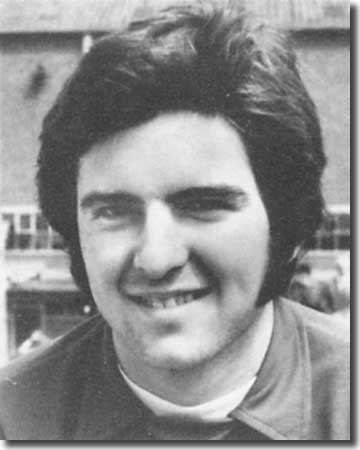 the standard of English Third Division and their quaint local band played
with more gusto than discipline. The same could not be said of the team.
Effective in defence and determined on attack, where Janssens and Denul
provided a weighty and adroit foil for Ressel's speed, Lierse often had
Leeds at full stretch. Leeds were sometimes woefully thin on the ground,
especially when Janssens chipped over a cross and Ressel, in space, brought
a clawing save out of Sprake.
the standard of English Third Division and their quaint local band played
with more gusto than discipline. The same could not be said of the team.
Effective in defence and determined on attack, where Janssens and Denul
provided a weighty and adroit foil for Ressel's speed, Lierse often had
Leeds at full stretch. Leeds were sometimes woefully thin on the ground,
especially when Janssens chipped over a cross and Ressel, in space, brought
a clawing save out of Sprake.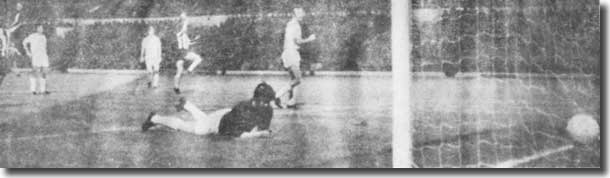 minutes
or so Leeds seemed to be in no apparent trouble. Lierse looked oddly unambitious
in attack, often having only two men up front and it seemed only a matter
of time before Leeds struck a telling blow, although it was obvious they
could have done with Giles' store of ideas.'
minutes
or so Leeds seemed to be in no apparent trouble. Lierse looked oddly unambitious
in attack, often having only two men up front and it seemed only a matter
of time before Leeds struck a telling blow, although it was obvious they
could have done with Giles' store of ideas.'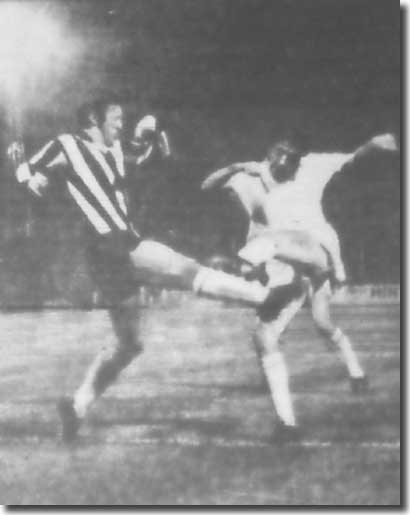 side and suffered accordingly. Lorimer hit the crossbar and Cooper and
Madeley both went close but not all the Belgians' defending was desperate,
even though Denul and Davidovic were both booked for fouls.
side and suffered accordingly. Lorimer hit the crossbar and Cooper and
Madeley both went close but not all the Belgians' defending was desperate,
even though Denul and Davidovic were both booked for fouls.