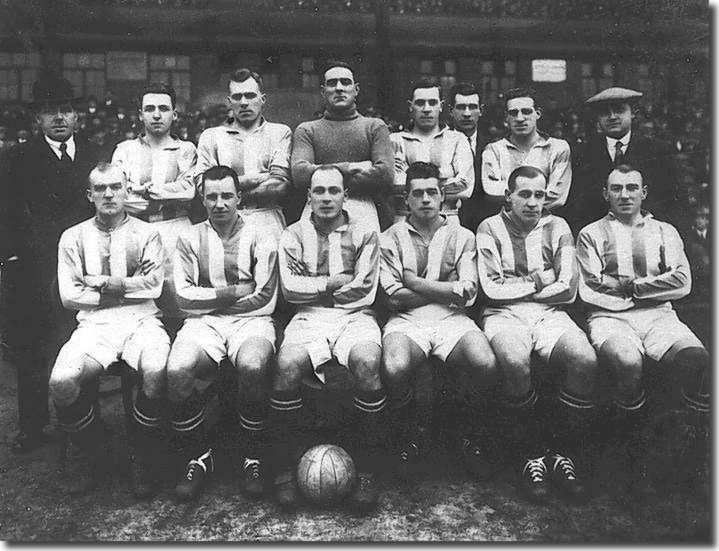
 After
achieving mid table security in their first season
back in the First Division, Leeds United had much to look forward
to in 1929/30. They went into the new season with much the same squad
in place as during their march to promotion in 1928,
only now they were a couple of years older and more powerful. Over the
previous year they had started building up their strength in depth and
a number of youngsters were signed from junior football: the two Milburn
brothers, Jack and George, brothers-in-law to keeper Jimmy Potts, and
Wilf Copping had arrived at Elland
Road. They were to give sterling service to the club over the next decade,
but for now they were just fresh faced reserves …
After
achieving mid table security in their first season
back in the First Division, Leeds United had much to look forward
to in 1929/30. They went into the new season with much the same squad
in place as during their march to promotion in 1928,
only now they were a couple of years older and more powerful. Over the
previous year they had started building up their strength in depth and
a number of youngsters were signed from junior football: the two Milburn
brothers, Jack and George, brothers-in-law to keeper Jimmy Potts, and
Wilf Copping had arrived at Elland
Road. They were to give sterling service to the club over the next decade,
but for now they were just fresh faced reserves …
The previous year had seen a surging start fade away into a disappointing
end of season run. When they went off at pace again in the new
season, there was concern that a similar fate was awaiting them,
but it never happened.
They kicked off with a disappointing 4-0 defeat at Arsenal, who the previous
season had also finished mid table, but then bounced back with an equally
one sided 4-1 trouncing of Aston Villa, who had been third in 1928/29.
They picked up just one point from their visits to Everton and Huddersfield,
but then hit a rich vein of form, coinciding with the introduction of
Jack Milburn into the team at left-back, replacing the experienced Bill
Menzies.
Harry Roberts had now regained the right-back spot from Tom Townsley,
but the half-back line of Willis Edwards,
Ernie Hart and George Reed was as dominant as ever. Bobby Turnbull, John
White, Tom Jennings, Russell Wainscoat and Tom Mitchell were a strong
attacking line-up.
Dave Mangnall and Charlie Keetley were able deputies for Jennings on
the occasions when his blood poisoning problems prevented him from playing,
and it was generally this body of players who saw United through the whole
season. Potts was displaced for more than half the season by Bill Johnson,
who spent most of his eight years at Elland Road in the reserves. Mangnall,
a young centre-forward and prolific scorer in the Midland League, scored
ten goals for Leedsin a Northern Midweek League game against Stockport
in a 13-0 win on September 25 1929, made his league debut four days later,
scored six times in nine consecutive league appearances, but was then
allowed to join Huddersfield two months later - prematurely, some felt
- where he continued to plunder defences.
Following a 2-1 home victory over Everton on 16 September, United won
seven of their next 8 matches, culminating in a 6-0 trouncing of Grimsby
on 2 November. They were sitting at the top of the league with 20 points
out of a maximum 26. On the way, they had defeated champions Sheffield
Wednesday, along with the rest of the previous year's top four. There
was a buzz going round Elland Road that had never been known before. The
defence was being very miserly and the forwards were carrying all before
them, with Turnbull and Wainscoat already hitting six and Mangnall five.
The old instability soon set in, however, and Leeds had a tough winter,
losing five on the bounce in November and December. However, they had
wins around the New Year period against Arsenal and at Villa Park, before
trouncing Crystal Palace of the Third Division (South) 8-1 in the FA Cup
third round. They were clearly not going to be as soft a touch as in previous
seasons and, even though they lost their fourth round tie 4-1 at West
Ham and had another three straight defeats in February and March, they
remained in contention right through to the end of the season.
back to top
Sheffield Wednesday ran away with things to retain their title with 60
points, but Leeds were among a clutch of other clubs in the top six separated
by just five points. They gave Wednesday a bloody nose 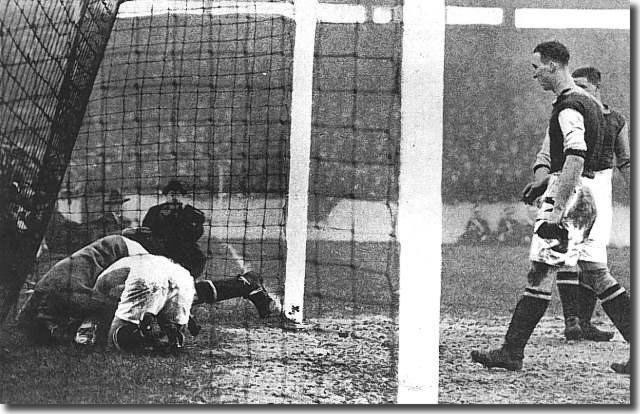 on
the way to the title, completing the league double over them with a 3-0
victory on 9 April. Keetley scored all three as he came into the side
strongly at the death, hitting ten goals in the last eight matches. United
beat Manchester City, who finished third, on the run-in, but had to settle
for fifth place, far and away the best finish by a United team before
the coming of Don Revie in the 1960's. A win away to mid-table Portsmouth
in the final match would have seen them third, but they could only manage
a goalless draw. It was disappointing, but there was a rosy glow around
Elland Road.
on
the way to the title, completing the league double over them with a 3-0
victory on 9 April. Keetley scored all three as he came into the side
strongly at the death, hitting ten goals in the last eight matches. United
beat Manchester City, who finished third, on the run-in, but had to settle
for fifth place, far and away the best finish by a United team before
the coming of Don Revie in the 1960's. A win away to mid-table Portsmouth
in the final match would have seen them third, but they could only manage
a goalless draw. It was disappointing, but there was a rosy glow around
Elland Road.
Manager Dick Ray had clearly
put together a side strong enough to compete with the best and
one that was now setting its sights even higher.
Other Football Highlights from 1929/30
- The 1930 FA Cup final between Arsenal and Huddersfield was a memorable
occasion with Gunners boss Herbert
Chapman seeing his current club beating one of his former charges
2-0 to win their first major honour and set up a golden decade for the
Gunners. The Graf Zeppelin flew over Wembley during the first half of
the contest
- Sheffield Wednesday retained the league title with Jimmy Seed again
captain and manager. When he joined the Hillsborough club from Spurs
in 1928 they were struggling against relegation
- England avenged their 5-1 defeat at the hands of the Wembley Wizards
in 1928 by beating Scotland 5-2 to win all three Home Internationals
and secure the championship outright for the first time since the War
- The first World Cup competition was held during the summer of 1930
in Uruguay. The hosts beat deadly rivals Argentina 4-2 in the final
on 17 July after being 2-1 down at half-time. There were no British
entries, the home countries having left FIFA in 1928, and the only European
teams competing were France, Belgium and Rumania