 |
 |
 |
 |
 |
 |
 |
 |
 |
 |
 |
 |
Second Division - Elland Road - 14,000
Scorers: None
Leeds City: Bromage, D Murray, Clark, Hargraves, Walker, Henderson, Parnell, Watson, D Wilson, Lavery, Singleton
Burnley: Green, Barron, Dixon, Cretney, Cawthorne, Moffat, Kenyon, Whittaker, R Smith, A Bell, A Smith
Leeds City's game with Burnley at Elland Road on 27 October 1906 was
the most momentous in the club's short history to that time. It City had just started getting their act together on the field after a
pretty dismal opening run. Three victories on the bounce, their first
of the season, had seen the team drag themselves up from 16th spot to
8th, seemingly ready to mount a genuine challenge for promotion from the
Second Division after a promising debut season when they had finished
sixth. Their Lancastrian visitors were level on points with City, but lay two
places higher on goal average. A fourth win for the Peacocks would have
seen them on the cusp of the promotion places. The Elland Road Selection Committee seemed to have finally settled on
their best eleven after being heavily criticised by club supporters earlier
in the season for continual chopping and changing - nine of the men who
faced Burnley had figured in each of the three preceding games. The exceptions were former Plymouth Argyle left-back Andy
Clark, returning after missing his first game of the campaign the
week before (a 2-1 victory at Port Vale), and James
Henderson, making his bow for the season in place of Jimmy Kennedy
at left-half. There had been a heavy storm the previous evening, but the newly installed
drainage system had done its job and left the turf in decent enough condition. Leeds City had the best of things in the first half and, according to
the Yorkshire Post, 'were almost incessantly attacking during the
first half, and there was some remarkably clever football by the whole
of the front line, though the Watson-Parnell
wing was the most prominent. The final onslaught on the Burnley goal was
never quite as deadly as the general plan of attack was fast and clever,
and for this reason, as well as Green's cool goalkeeping, no substantial
reward in points resulted. Wilson twice skimmed the bar with fast drives
after receiving from his wings, but generally the luck was against the
home side, and at the interval no points had been scored by either side.' The Wilson in question was David
'Soldier' Wilson, a powerful and committed centre-forward of Scottish
extraction, who had joined City from Hull the previous December for £150,
ending up top scorer with 13 goals from his 15 appearances. He could have
been sold at a quick profit but the City directors recognised his worth
and refused to sanction a move, although they received several offers
in excess of £500. A knee injury had restricted Wilson's appearances in
the current campaign and he had yet to trouble the scorers. Wilson was struggling to recover his best form, but had
done enough in the first half to signify that he could yet have an impact
on the outcome of the game, even though he had been winded by a clash
with two Burnley defenders and was not feeling fully himself. During the
break 'he expressed confidence that the team would just pull through.' Challenges became more robust after the interval and, according to the
Leeds Mercury, 'some of the players were guilty of Shortly after that, Wilson headed the ball goalwards and the effort seemed
to cause some sort of injury, for around the hour mark he was forced to
withdraw to the dressing rooms. He looked very pale and in great pain,
telling the club trainer George Swift
that 'he felt a heavy pain in his chest' but that he had not 'been charged
or fouled in any way, and could only think he must have strained himself
internally in jumping up to head the ball into the net'. With Wilson absent and the indisposed Lavery little more than a passenger,
Burnley started to get back into the game. Whittaker and Kenyon, the Lancashire
team's right wing pairing, twice came close to breaking the deadlock,
although City maintained their full share of the play. Things took a further turn for the worse when Harry
Singleton also sustained an injury. He remained on the field for a
while, but had to admit defeat and withdraw with fifteen minutes remaining
after another stiff challenge. Singleton's exit was the catalyst for the day's tragic conclusion. Soldier
Wilson was renowned for his bravery and commitment, and could not stand
idly by when he heard the news that his team were virtually down to eight
men. He screwed up his courage and decided to enter the fray once more,
despite the stringent advice of club doctors and officials. The Yorkshire
Evening Post: 'Though his chest was very sore, Wilson said he could
not remain there while the Leeds City team were in such straits. So, although
many of those in the room endeavoured to dissuade him from his purpose
he went out to resume play, his reappearance being greeted by a storm
of cheers.' It was quickly evident, however, that Wilson was neither use nor ornament
and that he was in no fit state to continue for long. His return had been
foolhardy in the extreme and, after three minutes and a single failed
attempt to play the ball, he withdrew once more, clearly in the most extreme
agony. There were only minutes left and still no score. Even though they were
in effect three men down and facing an uphill fight, it seemed However, the result was of little import at Elland Road. A rumour of
desperate tragedy was doing the rounds among the crowd, and a shock was
waiting for the City players when they reached the dressing room - David
Wilson had lost his life seconds before the end of the game. The sensational news spread around the city like wildfire. When Wilson had first left the field, police constable John Byrom, on
duty at the players' gate, was so concerned at the player's demeanour
that he followed him down to the dressing rooms. He found him writhing
in evident pain on the ground with chest pains. The policeman summoned
help, and was soon joined by three doctors, Dr Earnest Frederick Taylor,
the City Club's physician, Dr Fawcett, who was sitting in the stand, and
Dr Whittaker, the Burnley party's physician. Wilson was suffering intense
pain in the chest, neck and left arm. He was carried into the directors'
room, where Dr Taylor could find nothing definite to account for his condition,
although he assumed that he had had a heart attack. Dr Taylor: 'I thought
he was far too ill to ever think of returning to the field.' Eventually Wilson's condition started to stabilise and he felt a little
better. His wife, who had been in the stand, had driven off in distress
when Wilson had first been injured, and a cab was called to take him home.
However, when Wilson heard of the injuries to the other players, even
though his chest was still very painful, he insisted on going back out
onto the field. The doctors and club officials tried to dissuade him,
but Wilson would have none of it - he walked out of the room and returned
to the fray. According to PC Byrom: 'Five minutes later, he came off a second time.
I assisted him to the dressing room, and helped him to undress. He said
he would have a hot bath, but all at once after getting into the bath
he laid down and started kicking his legs violently. I took hold of him
and held his head out of the water, but he seemed to lose consciousness,
and never spoke again.' The officer, with the assistance of trainer George Swift, lifted Wilson
out of the bath and placed him on a table, where, in spite of the immediate
attention of Dr Taylor, he died within seconds. It was an immense shock to all present. Before the players left the dressing
rooms Wilson had appeared to be in good health, and told the club's secretary-manager
Gilbert Gillies that he felt perfectly fit. According to his wife, Wilson
had never seriously complained of ill health, although once or twice during
the past few weeks he had complained of being short of breath. Mrs Wilson
suggested that her husband smoked too much: 'He was a heavy smoker of
cigarettes, and I kept telling him they were the cause.' Wilson's body was taken by ambulance to the couple's house at 8 Catherine
Grove, Beeston Hill and their relatives, who lived in Leith, were telegraphed,
arriving the next day. On Tuesday morning a post mortem was held, together with an inquest,
as reported by the Yorkshire Evening Post: 'The inquest was held
at 'It was this same brother, by the by, who was in such a terrible state
of anxiety and uncertainty yesterday, as to whether it really was his
brother David who was dead. "Is it David Wilson, late of the Hearts
of Midlothian, who is killed?" he wired to Mr Gillies, but before
Mr Gillies' reply reached him his suspicions had been confirmed, and he
was on his way to Leeds.' The inquest determined that it was 'over eagerness to be of service to
his club that was Wilson's undoing. The doctor who was in attendance upon
him at the last expressed the emphatic opinion that the fact of going
on to the field a second time caused Wilson's death - that, in a word,
if he had remained in the directors' room he would have had a good chance
of getting better. 'The actual cause of death was angina pectoris, a medical term which
signifies what is more commonly known as heart anguish; and the jury at
today's inquest certified that Wilson had died from "heart failure,
from over exertion in a football match".' On the Wednesday morning, City directors and players met at Catherine
Grove for a service held by Reverend Mr Price, then went up by train from
North Eastern Station to the funeral in Leith. Leeds City paid for the
funeral and arranged a benefit match a few weeks later against Hull City
for Wilson's widow and their ten-month-old baby girl. It came as a surprise to many who knew him that Wilson was only 23-years-old,
having been born in the East of Scotland on July 23, 1883. Most people
who saw him would have taken him to be about 30, because of his heavy
fair moustache. He was one of three brothers who made their name as footballers in the
Army, and this led him to be familiarly known as Soldier Wilson. The Yorkshire
Evening Post: 'Wilson had had an interesting football career, the
story of which he related to the writer only a few months ago. He was
a native of Musselburgh, in the county of Midlothian, and in 1896 enlisted
in the Cameron Highlanders, with whom he went out to Gibraltar, where
he began playing Association football. Whilst at Gibraltar, Wilson transferred
to the 1st Battalion Black Watch, which regiment he accompanied to India,
and subsequently to South Africa, where, with Colonel Remington's column,
he took part in some of the Boer drives. 'It was after returning to England that he was bought out of the army
by the Dundee Club, for whom for a season or two he played at centre-forward
in the Scottish First League. Just two years ago he had his knee badly
twisted, and on his recovery he was transferred to the Hearts of Midlothian
Club, for whom he rendered yeoman service until joining Hull City. He
played at Anlaby Road in two or three matches last season, and then came
to Leeds City, the transfer fee paid for him being £150.' Many felt that Wilson had lost his form, but City secretary-manager Gilbert
Gillies retorted 'Those critics did not know Wilson. There were few better
centre-forwards in the country.' The demise of David Wilson is one of the greatest tragedies in the history
of Leeds City, but led directly to the arrival of the club's most celebrated
son. On 18 November, the Peacocks paid £350 to Lincoln City to secure
the services of Billy McLeod, a centre-forward who was even more productive
in front of goal than his predecessor. Over the 14 years that followed,
McLeod was to score a phenomenal 171 goals in 289 League games for the
club. The contributions of McLeod, however, were a future phenomenon. At the
start of November 1906, everyone connected with Elland Road was in a trough
of despair at the loss of a trusted and worthy colleague. David Wilson
would be sorely missed and his death left a shadow over the club.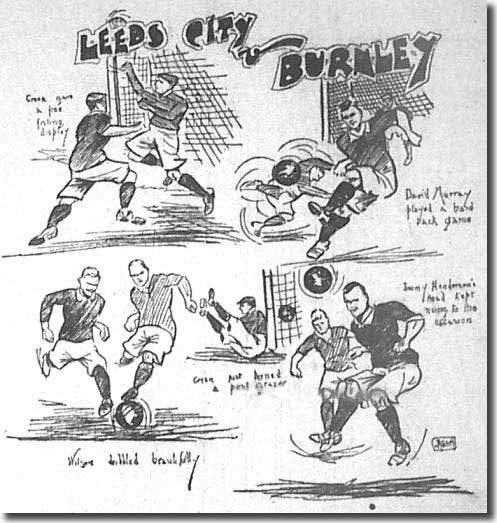 was
memorable for the most tragic of reasons: the contest was marred by one
of the earliest recorded deaths of a football player during a first-class
match.
was
memorable for the most tragic of reasons: the contest was marred by one
of the earliest recorded deaths of a football player during a first-class
match.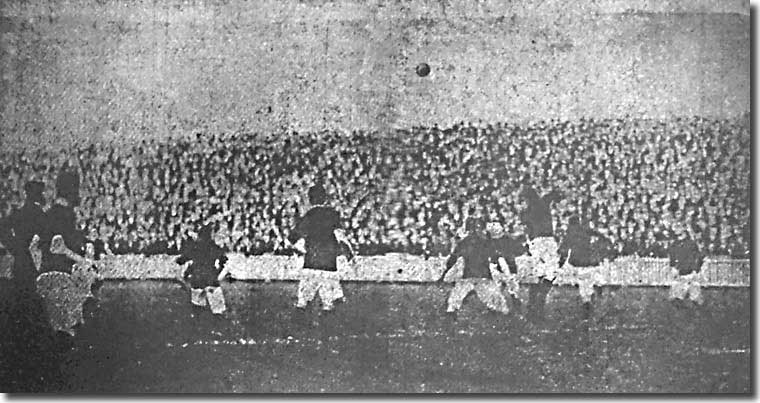 tactics which, to say the least, were of too vigorous a character. Lavery
and Singleton were working nicely towards the Burnley goal when Lavery
was tripped from behind, and fell heavily on his head. The little inside-left
was stunned, and it was several minutes before he was brought round. The
incident called for stern action by the referee, but that official only
cautioned the offending Burnley player, when even Burnley officials on
the stand were agreed that the culprit should have been sent off. Lavery
was almost quite useless after this, so that Leeds were practically playing
with ten men.'
tactics which, to say the least, were of too vigorous a character. Lavery
and Singleton were working nicely towards the Burnley goal when Lavery
was tripped from behind, and fell heavily on his head. The little inside-left
was stunned, and it was several minutes before he was brought round. The
incident called for stern action by the referee, but that official only
cautioned the offending Burnley player, when even Burnley officials on
the stand were agreed that the culprit should have been sent off. Lavery
was almost quite useless after this, so that Leeds were practically playing
with ten men.'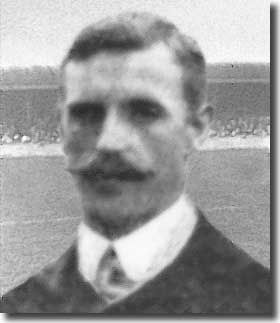 that
Leeds City would be able to hold out for the goalless draw that their
pluck had merited as David Murray and goalkeeper Harry
Bromage performed wonders in keeping the Lancastrians at bay. It was
not to be, however, and in the closing seconds Bell, the Burnley inside-left,
received the ball from a free kick and steered his shot beyond Bromage
to settle the game.
that
Leeds City would be able to hold out for the goalless draw that their
pluck had merited as David Murray and goalkeeper Harry
Bromage performed wonders in keeping the Lancastrians at bay. It was
not to be, however, and in the closing seconds Bell, the Burnley inside-left,
received the ball from a free kick and steered his shot beyond Bromage
to settle the game.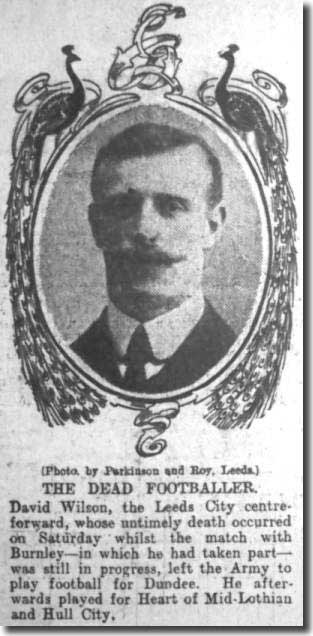 the Imperial Hotel, Beeston, before the City Coroner (Mr J C Malcolm).
There were present at the inquiry Messrs R Younger, Dimery, A Eagle and
J Oliver (directors of the Leeds City Club), Mr Clayton (financial secretary)
and Mr Gillies (the secretary and manager). Amongst those present were
some of the deceased's relatives, including an uncle, who brought him
up as a child, and a brother - a manly young fellow from the Black Watch,
the deceased's old regiment, who, in his Highland uniform, was a sad auditor
of the proceedings.
the Imperial Hotel, Beeston, before the City Coroner (Mr J C Malcolm).
There were present at the inquiry Messrs R Younger, Dimery, A Eagle and
J Oliver (directors of the Leeds City Club), Mr Clayton (financial secretary)
and Mr Gillies (the secretary and manager). Amongst those present were
some of the deceased's relatives, including an uncle, who brought him
up as a child, and a brother - a manly young fellow from the Black Watch,
the deceased's old regiment, who, in his Highland uniform, was a sad auditor
of the proceedings.