Part 2 - The Leeds United trial - Part
3 A season falls apart - Part 4 A summer
of change - Results and table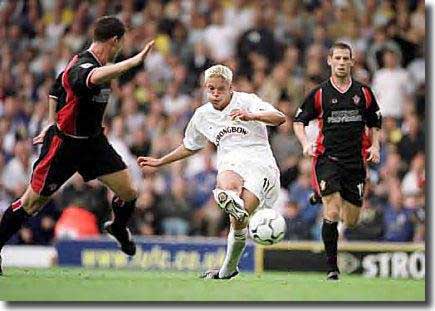
After the heady excitement of Leeds United's debut season in the Champions'
League, the summer of 2001 was one of consolidation, as manager David
O'Leary and chairman Peter Ridsdale concentrated on retaining their players
rather than strengthening the squad.
There were no close season signings, while the club's rivals were splashing
out big money to reinforce their own assault on the silverware. Arsenal
brought in Francis Jeffers, Giovanni van Bronckhorst and Sol Campbell,
while Chelsea strengthened their midfield by signing Frank Lampard and
Emmanuel Petit. Champions Manchester United went even further by breaking
the British transfer record twice, first by finally capturing long-term
target Ruud van Nistelrooy, and then adding the Argentinian midfielder
Juan Sebastian Veron.
The management at Elland Road instead concentrated on securing the future
of a number of their stars, with Mark Viduka and Olivier Dacourt negotiating
improved five-year deals, despite the constant rumours that they would
soon be plying their trade on the continent.
A lack of signings, however, had to be set in the context of the team's
excellent form in the spring, when they had been so close to unexpectedly
seizing another Champions' League qualification. They had been the outstanding
form side of the last four months so began from a position of strength.
Leeds kicked off their season with a satisfying 2-0 win at home to Southampton.
The win flattered United, who had struggled to break down a tight defence,
and there was a lack of sharpness up front. It took until the 68th minute
for Lee Bowyer to break the deadlock with a low shot from the edge of
the area after a corner had only been partially cleared, but substitute
Alan Smith, who had been left on the bench as Viduka and Robbie Keane
got O'Leary's initial vote of confidence, gave the scoreline a comfortable
look with a well taken second ten minutes from time.
The ball had been played up to Smith on the edge of the area, with his
back to goal, but his smart back heel and turn threw Dean Richards completely
off balance, giving the new England international the space to finish
in some style. O'Leary acknowledged that it had been Smith who had made
the difference: 'Alan always livens things up and he scored a wonderful
goal. They came to nullify us. But Manchester United often win with late
goals in games. They grind people down and that's what we have to do.
We must be clinical.'
The side's resolve and patience were to be tested to the extreme three
days later when they faced one of their biggest challenges of the season,
a trip to Highbury to meet a powerful Arsenal side, who had kicked off
their own season with a heavy win at Middlesbrough.
Relations between Leeds and Arsenal had been bad tempered for years.
With 41 bookings and two red cards in the previous six encounters between
the two sides, referee Jeff Winter had reason to expect a busy night and
he wasn't disappointed. Tension was high and neither side was willing
to give any quarter. Challenges flew in from the off, and the Leeds performance
was reminiscent of some of their more ugly encounters of the 1960's, as
they fought like tigers for the points.
Mark Viduka escaped with a lecture for a tackle on Robert Pires inside
the first minute, while Danny Mills got a strong word from the referee.
Winter's patience failed him, however, after eight minutes following a
tackle from behind on Ray Parlour by Eirik Bakke, and the Norwegian received
a yellow card. Bakke's midfield partner Olivier Dacourt followed him into
the book a couple of minutes later after a foul on his fellow Frenchman,
Patrick Vieira.
Leeds' characteristic spirit was getting out of hand and Lee Bowyer and
Mills soon also received cautions for ferocious challenges on Arsenal
players. United were determined not to allow the Gunners to get into their
stride, but allowed their 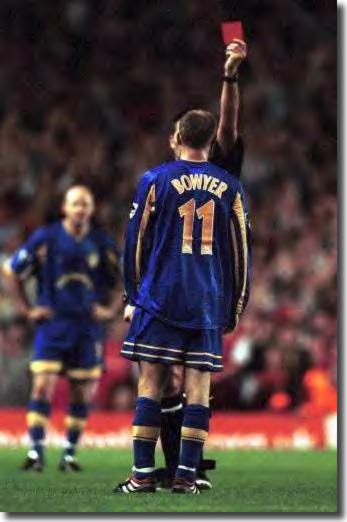 rashness
to run over, and Arsenal were having the better of the football that did
take place.
rashness
to run over, and Arsenal were having the better of the football that did
take place.
However, Leeds continued to battle for possession and as the half-hour
mark passed they gained an unexpected reward. Mills went racing towards
the area and was checked just outside by Robert Pires. Arsenal keeper
David Seaman began lining his protective wall up, but Ian Harte showed
great presence of mind, asking the referee if he could take the free kick
quickly. The Irishman curled a 20-yard shot inside the left hand post
as Seaman was caught completely cold. Arsenal protested vehemently that
they had not been ready, but all their arguments were waved aside by Winter.
The Gunners, however, quickly forgot all the perceived wrongs when they
fashioned a neat equaliser soon afterwards. Full back Ashley Cole was
given too much space on the left flank and fired a low cross into the
area. Sylvain Wiltord threw himself at the ball and guided a low header
through a crowded area and into the far corner of the goal.
David O'Leary made a smart tactical change just one minute after the
restart when he pulled off Alan Smith, who had taken a knock on his ankle
in the first half, and sent on David Batty to bolster the midfield, with
Harry Kewell deployed out wide on the left. The change allowed Leeds to
compete more evenly against the Gunners' dominating midfield.
Clearly, the Yorkshire side's primary target was to avoid defeat, but
they regained the lead after 52 minutes with a sweetly worked move. Kewell
was having some joy on the left flank and fed Mark Viduka on the left
hand corner of the box. The striker bought himself some space and slipped
away from his marker, Tony Adams. The Aussie didn't need a second chance
and drove the ball back low in at Seaman's right post to leave the Gunners
deflated.
back to top
Leeds retreated into their shell after that, content to hang onto what
they had got. However, they had little other option as both Bowyer and
Mills were dismissed after second bookable offences. Gary Kelly and Jonathan
Woodgate were sent on in the closing stages to bolster a stretched defence,
and somehow Leeds held on for a precious three points against one of their
fiercest rivals for the Premiership.
Manager O'Leary paid tribute to the resilience and magnificent spirit
of his side afterwards, insisting it had 'not been a dirty game'. The
Leeds boss hailed his gutsy team's performance: 'It's right to want to
clean the game up but some of the bookings for both sides left a lot to
be desired. I would rather leave it to the experts to discuss though.
They don't get into trouble but I do. I enjoyed getting the three points.
'If you are going to do anything good, like getting into the Champions'
League, you have to come to places like this, a great stadium and a great
team, and get three points when you are not playing well. I have twice
won a championship here and it's about getting results when you are not
playing well. These are three fantastic points as this is a club who can
beat anyone here.
'We showed a great spirit of togetherness. They did superbly at the end
trying to block and cover for each other. The spirit got us through.'
Outside of Elland Road, the club got fierce criticism for an ugly lack
of discipline, but the side had two wins out of two and lay second in
the table. Two goalless draws, at West Ham, and then at home to shock
pace setters Bolton Wanderers, kept the club in the early running, but
seemed to confirm that Leeds did not have enough to offer up front, although
their record of just one goal conceded in four games highlighted a new
found meanness at the back.
Danny Mills had missed the Bolton game through suspension, but the back
five of Nigel Martyn, Mills, Rio Ferdinand, Dominic Matteo and Ian Harte
which had been so outstanding throughout the closing run of 2000/01 had
carried their wonderful form into the new campaign. When Mills' goal against
his former club Charlton, following a Robbie Keane opener, secured a 2-0
victory a week later, Leeds moved to top spot for the first time, and
then a 3-0 demolition of Derby at Elland Road, with Harry Kewell bagging
a couple, confirmed Leeds' ability to win points, although they were still
not firing on all cylinders.
Either side of the Derby match, UEFA Cup action had kicked off, and an
unexpected 1-0 reverse away to Portugal's CS Maritimo in the first leg
was rendered irrelevant by a routine 3-0 victory in the return at Elland
Road. Leeds had been dreadful in the first leg, although the goal had
been unfortunate, and even at home they were still scrapping for true
form. 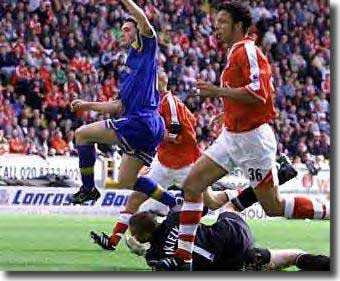 However,
O'Leary's team had flattered to deceive with their form in previous seasons,
and now it was the results which mattered rather than the manner in which
they were achieved.
However,
O'Leary's team had flattered to deceive with their form in previous seasons,
and now it was the results which mattered rather than the manner in which
they were achieved.
Back in the Premiership, Leeds came from a goal down at Ipswich to win
2-1, while something resembling decent form returned when a struggling
Leicester team were demolished 6-0 at Filbert Street in the Worthington
Cup. Robbie Keane's hat trick was the highlight of a game in which Leeds
always had the upper hand, after the young Irishman opened the scoring
with eleven minutes gone.
That wonderful victory put the side in good heart for a testing run of
Premiership challenges, Liverpool at Anfield, Chelsea at Elland Road and
Manchester United at Old Trafford, as October drew on. Those three games
would reveal a lot about Leeds United's mettle as true challengers for
the title.
Leeds kicked off at Anfield on 13 October with the confidence built by
their good opening run, and a three point advantage over their nearest
rivals, Arsenal and Manchester United. Leeds just about shaded the contest
and went in at the interval with the lead their football deserved. Harry
Kewell had been marshalled well on the left flank by Jamie Carragher,
but won a corner after 27 minutes. Ferdinand rose at the far post to nod
the ball back across the area and Leeds old boy Gary McAllister could
only head weakly out towards Kewell. He shot from 12 yards out at some
pace and the ball beat goalkeeper Jerzy Dudek after a deflection.
The interval came at the right time for the Anfield side for Leeds had
started to exert some control. During the break Liverpool boss Gerard
Houllier felt some chest pains and abandoned his team talk, leaving for
checks in hospital. He was to miss much of the season. Reds assistant
Phil Thompson took charge and withdrew Emile Heskey, throwing on the Finn
Jari Litmanen after the break, and the Reds were transformed, coming much
more strongly into the game.
Litmanen was at the heart of all Liverpool's best moves now, although
they were still only rarely troubling Nigel Martyn. However, just as Leeds
looked to have weathered the storm, the Anfield club unexpectedly fashioned
an equaliser.
England striker Robbie Fowler was given far too much space on the edge
of the box, finding the room to turn onto his favoured left foot and chip
Martyn. The crossbar saved a scrambling keeper, but only temporarily as
the ball bounced down, allowing Danny Murphy to nod home into the unprotected
net.
Both teams pushed for the winner from then on but there were relatively
few clear chances and the match finished with honours even and Leeds still
heading the Premiership table, although their lead was now down to a single
point.
A week later, while Liverpool won 4-1 at Leicester to move up to fourth,
Arsenal and Manchester United both dropped points, with Bolton's startling
win at Old Trafford further evidence that something was seriously wrong
with Sir Alex Ferguson's side.
Leeds remained on top after a bad tempered goalless draw at Elland Road
against Chelsea. The main talking point was a clumsy two-footed challenge
by Graeme Le Saux on Danny Mills, which merited a red card but only brought
a caution. David O'Leary was less fortunate when he berated referee Paul
Durkin in the tunnel at half time over the incident, being dismissed for
his trouble!
A week later, and a third massive challenge, with a trip to Old Trafford
to face Manchester United.
Despite the dropped points against Liverpool and Chelsea, Leeds still
retained a confident air, and 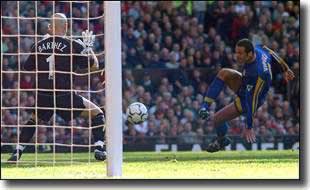 even
though United pinned them back in the first half with a succession of
chances, the Elland Road side were unlucky on several occasions. Surprisingly
there was still no score at half-time, but the ill feeling between the
two sides surfaced at the start of the second half. England captain David
Beckham fouled Robbie Keane, and the Irish striker was lucky to escape
with a yellow card when he retaliated with a push.
even
though United pinned them back in the first half with a succession of
chances, the Elland Road side were unlucky on several occasions. Surprisingly
there was still no score at half-time, but the ill feeling between the
two sides surfaced at the start of the second half. England captain David
Beckham fouled Robbie Keane, and the Irish striker was lucky to escape
with a yellow card when he retaliated with a push.
Keane celebrated his escape by seemingly giving Leeds the lead on the
hour mark. He took a quick free kick that left Fabien Barthez without
a prayer, but Dermot Gallagher disallowed the goal because he was still
trying to get the United wall back the full ten yards.
It was one of Keane's final contributions as David Batty replaced him
after 70 minutes in a move designed to shore up the Leeds midfield. Harry
Kewell was pushed up on the left and brought a new threat. Olivier Dacourt
released the Australian on the left, creating an opening for Ian Harte
to fire a cross through the area. Mark Viduka, running across to the right,
looked like he had miscalculated the ball's flight, but somehow reached
it on the edge of the six-yard box to hook the ball back past Barthez
to give Leeds the lead after 78 minutes.
back to top
Manchester United rose to the challenge and pressed the Yorkshiremen
back, but it looked like the Ferdinand-Matteo combination would be good
enough to secure the win. However, with just four minutes remaining, the
ever-reliable Norwegian Ole Gunnar Solskjaer, brought on to replace Nicky
Butt, rose at the far post to beat Martyn with a looping header.
Leeds could even have lost in the last few minutes when Martyn pulled
off two last ditch saves to deny Ruud van Nistelrooy, but it would have
been cruel justice indeed if they had returned to Yorkshire pointless.
Nevertheless, they lost their lead in the Premiership with Aston Villa's
win over Bolton later in the day enough to relegate Leeds to second.
Afterwards David O'Leary admitted he was disappointed that his side had
not gone for the win, saying 'It was a good match, a terrific match. I'm
disappointed because when we got the goal we sat back and I wanted us
to go from there. I felt we should have won because we were controlling
the game. This is why we've got to mature and we've got many years yet
to do that. They are a fantastic bunch of lads who give everything for
me. There's great spirit here, believe me, there's a great hunger.'
O'Leary could console himself with the thought that his side had emerged
relatively unscathed from a tricky run, during which they had won through
to the third round of the UEFA Cup and secured another promising young
player in England hopeful Seth Johnson.
Johnson had been signed for £7m from Derby County and at just 22 was
further evidence of O'Leary's policy of signing young British players.
His new captain Rio Ferdinand was convinced of the quality of the signing:
'Seth is a good young player who has obviously chosen to come to Leeds
to improve as a player and win things. He's a quality player who has played
for England and I was with him on that occasion. Having been at Derby
for a couple of years he has made his name, and if he regards this move
as a step up then brilliant, as this club is only going in one direction
and that is up.'
Leeds' progress in Europe had been uncertain and only a late goal by
Robbie Keane in the away leg against France's Troyes in the second round
managed to see them through. Their form had been as patchy as in the first
round against Maritimo and the French team had shown the better spirit
in their 4-2 defeat at Elland Road. In the return, Troyes had taken a
3-1 lead to move ahead on away goals before their tricky winger Loko had
the chance to put the tie beyond doubt on the hour mark. However, he panicked
when put clear eight yards out and fired over the bar.
With just 13 minutes to go, David Batty's uncharacteristic break into
the area allowed Mark Viduka to chip ahead and Robbie Keane ran on to
head home an undeserved goal. Nevertheless, few United fans complained
at the result.
It was odd really, because in the previous few seasons Leeds had failed
to secure the points their football had merited, while in 2001/02 the
reverse had applied. It was noticeable that the team still had to catch
fire and had demonstrated only patchy moments of quality. Their defensive
strength was reminiscent of former triumphs, but an irritable, frustrating
approach also echoed the style that Don Revie's team had perfected in
the 1960's. Danny Mills, Lee Bowyer and Alan Smith had earned reputations
for poor discipline, and David O'Leary seemed singularly unable to do
anything about it.
Another patchy victory, against Tottenham at Elland Road as the season
entered November, saw Leeds regain top spot, but they were desperately
lucky with only two defensive blunders in the second half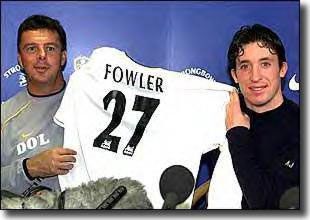 allowing them to come back after falling behind to Gus Poyet's opener.
A couple of weeks later, their luck gave out when they crashed 2-0 at
Sunderland, losing their unbeaten record in the Premiership and their
leading spot.
allowing them to come back after falling behind to Gus Poyet's opener.
A couple of weeks later, their luck gave out when they crashed 2-0 at
Sunderland, losing their unbeaten record in the Premiership and their
leading spot.
A week later there was another bad-empered clash, at home to Aston Villa.
Alan Smith was dismissed for the fifth time in his career after apparently
elbowing Turkish defender Alpay. Smith had earlier given Leeds the lead,
and United didn't allow the pace to drop after his dismissal, but let
their concentration slip, giving Hassan Kachloul the chance to equalise
after 33 minutes. They had opportunities to restore their lead as they
dominated the rest of the game, but struggled to score.
Just days later, it seemed that David O'Leary had lost all patience with
forwards who were guilty of foregoing chance after chance and agreed a
fee of £11m with Liverpool for the transfer of Robbie Fowler.
The 26-year-old had suffered under Liverpool's rotation system and found
himself falling behind Michael Owen and Emile Heskey in the Anfield pecking
order, which he quoted as the main reason for his move: 'I have had nearly
15 years with Liverpool and eight wonderful years in the Liverpool team.
But I think it must be obvious to everyone that the time has come to move
on. It was always going to be a difficult decision to leave Liverpool,
because even if I have my own reasons, the fans there were a powerful
reason for me to stay. But Leeds are a great club, and the chance to be
part of what is happening at Elland Road was too good to miss, particularly
under the current circumstances. Like every footballer, I just want to
play, and I want the chance to be part of things. I'm not interested in
recriminations, but I think this is the best thing now for me and for
Liverpool. Leeds have a fantastic young side, and it is clear that things
are happening there. The chance to be part of that is a very exciting
prospect for me.'
It took Fowler a while to find his shooting boots, and his debut came
in a drab goalless draw at Fulham, as Leeds started to struggle to see
off supposedly lesser opposition. Two goals from a very off colour Harry
Kewell earned a well deserved 2-1 victory at Blackburn, but even a two
goal lead at home to Leicester, who were struggling against relegation,
could not secure a win as the Filbert Street side fought back in the closing
seconds to escape with a 2-2 draw.
Even when Fowler did manage to find the net, with two at home to Everton
on December 19 helping to establish a 3-0 lead, a suddenly frail Leeds
defence evaporated, leaking two goals and only just holding on for a now
rare victory. It was enough, however, to move Leeds back up to third place.
Off the field, however, more significant matters were coming to a head.
Things were happening which had a long term impact on both Leeds' season
and spirit within the Elland Road club.
Part 2 - The Leeds United trial - Part
3 A season falls apart - Part 4 A summer
of change - Results and table
back to top